
Best Team Comp, Rotation, Skills Explained & Is He Worth Building?
So… you pulled Li Feng from the beginner banner and then hit YouTube, only to find basically nothing. No clear guides, no rotations, no “is he even good?” answers. Yeah — you’re not alone.
If you’re searching things like “Li Feng build,” “Li Feng team comp,” “Li Feng rotation,” or “Is Li Feng worth building?”, this guide is here to save you time. No theory overload, no hype — just how Li Feng actually works, how to build him properly, and whether you should invest your resources or not.
Li Feng is one of those operators that feels confusing at first because the game doesn’t clearly explain what his role is supposed to be. He’s not a traditional hard carry, and he’s not a pure support either, which leads a lot of players to think he’s weak or poorly designed.
In reality, Li Feng is very much a “play him correctly or he feels bad” character. When used the right way, he can noticeably boost your team’s damage and make Physical comps feel smoother and stronger.
This guide breaks everything down in plain language so you can decide, with confidence, whether Li Feng deserves your resources and how to get real value out of him.
Is Li Feng Good & Worth Building?
Short answer: yes — but only if you use him the right way.
Li Feng is worth building if you fall into the right use case. He works best when you’re running Physical damage teams, especially teams that rely heavily on skill-based DPS and burst skills rather than constant basic attacks.
If your goal is to make your overall team hit harder during key moments, Li Feng fits that role very well. He shines as a unit that enables damage rather than being the sole source of it.
What Li Feng is not meant to do is hard-carry stages on his own. He isn’t designed to solo enemies or delete waves by himself. Instead, his real value comes from setting up burst windows by applying Physical vulnerability and boosting your team’s skill damage at the right time.
When you play him as a support-leaning sub-DPS and time his skills properly, he feels impactful and rewarding. If you expect him to act like a standalone carry, though, he will naturally feel underwhelming.
What Role Does Li Feng Actually Play?
- Rarity: 6★
- Class: Polearm Guard
- Damage Type: Physical
- Role: Sub-DPS / Physical damage amplifier
Li Feng’s job isn’t to top the damage chart by himself — it’s to set the pace of the fight. Think of him as the operator who starts things off the right way. He jumps in early, applies debuffs to weaken enemies, and creates a short but powerful window where your team’s next skill burst hits much harder. After that, he stays on the field to help clean up with steady Physical damage.
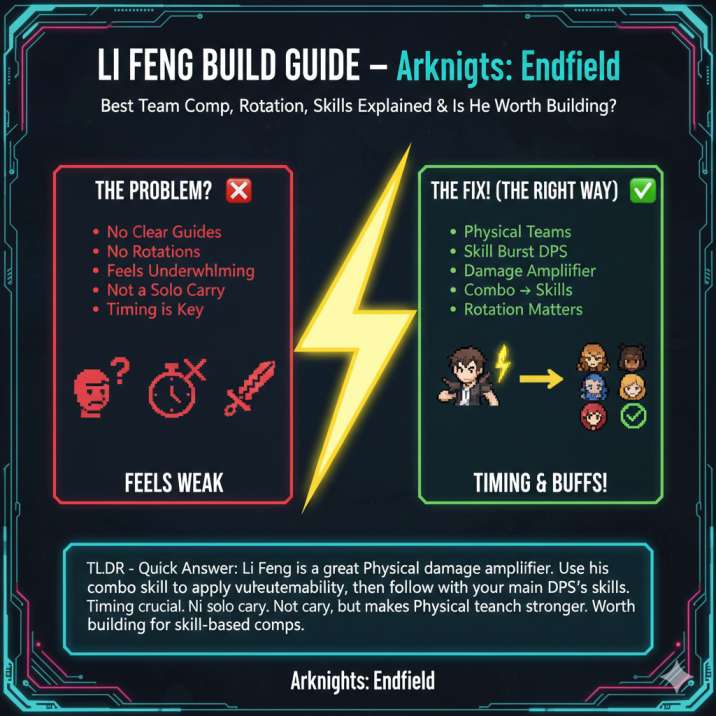
Because of this, Li Feng is all about timing and coordination, not raw numbers. If you line up his skills with your main DPS correctly, he feels strong and valuable. If you throw him in without a plan and expect him to carry alone, his damage will naturally feel unimpressive.
Li Feng Skills Explained (No Overthinking)
You don’t need a spreadsheet or deep theorycrafting for Li Feng — his kit is actually pretty straightforward once you know what to look for.
Combo Skill (Most Important):
This is the core of Li Feng’s entire playstyle. His combo skill applies Physical vulnerability to enemies and boosts skill damage for your team for a short window. Everything you do with him revolves around this ability. It’s not meant to be spammed on cooldown; it’s meant to be timed so your team can take full advantage of the buff.
Follow-up / Damage Skill:
After the combo window ends, Li Feng switches into a more standard sub-DPS role. This skill is used to deal steady Physical damage, help clean up remaining enemies, or maintain pressure while you wait for the next burst opportunity.
👉 The key rule: always use Li Feng’s combo skill right before your main DPS activates their skills.
If the timing is off, Li Feng will feel weak and underwhelming. If you line it up correctly, your team’s damage spikes hard and the value of bringing him becomes immediately obvious.
Best Li Feng Build (Stats & Gear Priority)
Getting Li Feng to feel good mostly comes down to stat focus and timing, not chasing some ultra-specific weapon.
Stat Priority (In Order)
- Attack (ATK) – this is your biggest priority and the main thing that makes his skills hit harder
- Skill Damage / Skill Scaling – directly improves the value of his combo and follow-up skills
- Crit / Hit – only worth considering if it doesn’t cost you ATK or skill damage
- HP / Defense – purely situational, and only needed if he’s dying too often in your setup
If your Li Feng feels weak or underwhelming, it’s almost always because one of these things is wrong:
- His ATK is too low
- He’s missing skill damage bonuses
- His combo skill isn’t being synced properly with your main DPS
Weapon Tips
Stick to a polearm with high ATK. Any secondary effect that boosts skill damage, Physical damage, or debuff effectiveness is a solid bonus. Exact “best weapons” will vary depending on your pulls and progression, but the general rule is simple: ATK plus skill scaling beats everything else.
Best Li Feng Team Comp (What Actually Works)
Strong Physical Team (Meta-Style)
- Main DPS: Da Pan or Pogranichnik
- Sub-DPS / Amplifier: Li Feng
- SP Battery / Support: Pogranichnik (support build) or Akekuri-type units
- Healer / Buffer: Any reliable healer ( Gilberta-style units really shine here )
- Flex Slot: Utility, crowd control, or extra Physical damage
Why this works:
This setup plays straight into what Li Feng does best. He opens the burst window with his combo skill, applying Physical vulnerability and boosting skill damage. Your main DPS immediately dumps their skills into that buffed window for big numbers, while SP support keeps everyone ready so rotations don’t fall apart. It’s clean, consistent, and forgiving — exactly what you want for Physical comps in mid-to-endgame content.
Beginner / F2P-Friendly Team
Good news: you don’t need perfect units or meta pulls to make Li Feng work.
A simple, beginner-friendly setup looks like this:
- 1 Physical DPS with a strong skill
- Li Feng
- 1 SP generator
- 1 healer
- 1 flex unit (extra damage, utility, or crowd control)
That’s it. No complicated requirements, no rare-only lineup. As long as your main DPS actually benefits from skill damage, Li Feng will do his job. He sets up the burst window, your DPS cashes in, and the rest of the team keeps things stable.
This kind of team is easy to build early on and scales well as you upgrade gear and unlock better operators. If you’re free-to-play or still learning the game, this setup lets you get real value out of Li Feng without forcing you into specific characters or banners.
Li Feng Rotation (How to Play Him Correctly)
This is the part most guides skip — and it’s also the main reason people come away thinking Li Feng is weak. His damage doesn’t come from mashing skills on cooldown; it comes from clean, deliberate timing.
Standard Rotation
- Deploy your SP support first so skills charge on time
- Deploy Li Feng and make sure he’s within healer range
- Wait until your main DPS skills are ready — this step matters
- Activate Li Feng’s combo skill to open the burst window
- Immediately activate your main DPS skill(s) to take full advantage of the buff
- Use Li Feng’s follow-up skill to clean up remaining enemies
- Save the combo for the next heavy wave instead of wasting it early
Boss Fights
- Don’t waste Li Feng’s combo on trash mobs
- Save it specifically for elite enemies or boss phases
- Remember: timing > stats
If your damage feels low, it’s almost always bad timing, not bad gear. Get the rotation right, and Li Feng’s value becomes very obvious.
Li Feng Weaknesses (And How to Fix Them)
Like any operator, Li Feng isn’t perfect, and knowing his weaknesses makes a huge difference in how good he feels to play.
Weaknesses
- He relies heavily on teammates having SP ready, since his value comes from syncing skills
- He’s not great in long, slow sustain fights where burst windows don’t matter much
- Being Physical-focused, he can struggle against enemies with very high armor
How to Fix Them
- Always bring an SP battery so your DPS skills are ready when Li Feng’s combo comes up
- Pair him with skill-based DPS that can fully take advantage of his damage buff
- Don’t treat him as a main carry — use him as a setup and amplifier, not the star of the show
Play around these limitations and Li Feng feels consistent and reliable instead of underwhelming.
Common Li Feng Questions
Is Li Feng good for beginners?
Yes. He’s especially good if you pull him early, as long as you understand how his rotation works. Li Feng teaches proper timing and burst setup, which pays off later as you build stronger teams.
Is Li Feng a main DPS?
No. Li Feng is a sub-DPS and damage amplifier, not a primary carry. His job is to make your main damage dealer hit harder, not to do all the work himself.
Why does my Li Feng feel weak?
This usually comes down to one of three things:
- His combo skill isn’t synced with your DPS skills
- His ATK is too low
- Your team doesn’t rely on skill damage, so his buff isn’t being fully used
Is Li Feng worth building long-term?
Yes, if you plan to run Physical teams into mid-to-endgame content. When built and played correctly, he continues to add value as your roster improves.
Final Verdict
Li Feng isn’t flashy, broken, or brain-dead — and that’s exactly why he gets misunderstood. When used properly, he’s one of the better Physical team enablers in Arknights: Endfield, offering consistent value through debuffs, burst setup, and smart timing rather than raw solo damage.
If you pulled him from the beginner banner and you plan to play Physical comps, Li Feng is absolutely worth building. Put in the effort to learn his rotation, pair him with skill-based DPS, and he’ll quietly make your entire team perform better.
Read more articles: