
Let’s be real: farming in Hytale isn’t immediately obvious. You plant a few crops, poke some animals, and suddenly you’re wondering why nothing is growing the way you expected. If you’re here trying to figure out how farming actually works, what’s worth doing early on, and what systems are half-baked right now, you’re in the right place.
This guide cuts through the guesswork. Everything below is based on hands-on gameplay and how the systems behave right now, not how they might work later.
What makes farming in Hytale tricky is that it doesn’t always follow the rules you might expect from other sandbox survival games. Some mechanics are fully functional, others are clearly still being fleshed out, and a few features exist in a “kind of works, kind of doesn’t” state. That can make early farming feel confusing or even pointless if you don’t know what to focus on.
The goal here is simple: save you time. Instead of testing every crop, animal, or item yourself, this guide breaks down what actually works, what’s worth investing in early, and what you can safely ignore for now. Whether you’re setting up your first small farm or trying to figure out why certain systems feel inconsistent, this should give you a clear, frustration-free starting point.
How Farming Works in Hytale (Quick Overview)
Farming in Hytale is built around four main pillars: crops, animals, fertilizer, and renewable resources like mushrooms and fish. Some mechanics are solid, others are clearly still in progress, so knowing where to invest your time makes a big difference.
You can grow crops with seeds, raise animals for materials, and boost efficiency with fertilizer—but automation and breeding are far more limited than you might expect.
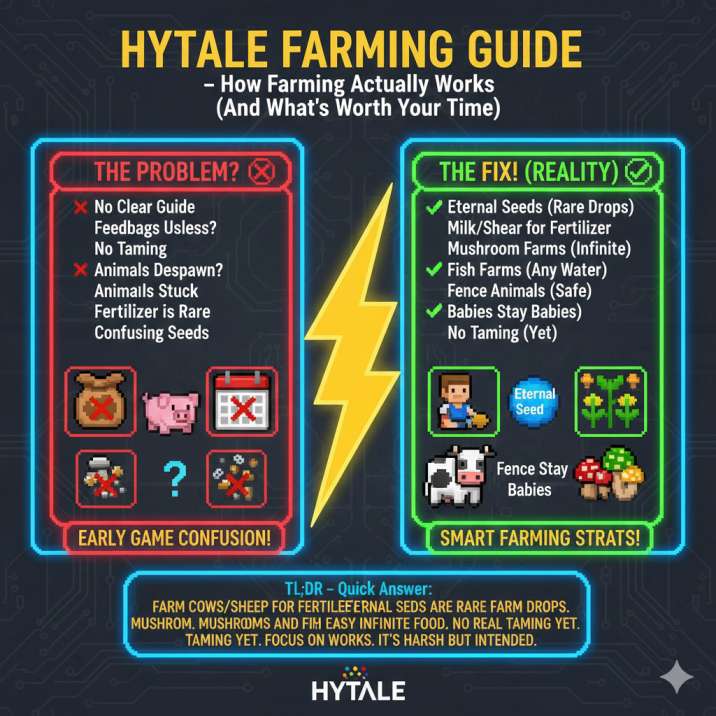
What trips most players up is assuming farming works like it does in other sandbox games. In Hytale, many systems are more manual and situational. Crops don’t always scale efficiently without the right setup, animals won’t passively produce everything you might expect, and some features feel intentionally restrained for now.
That doesn’t make farming useless—it just means smart planning matters more than raw size. If you understand these limits early, you can avoid wasting time on systems that aren’t fully rewarding yet and focus on the ones that consistently pay off.
Seeds Explained: Normal vs Eternal
There are two types of seeds you’ll deal with while crop farming.
Normal seeds are consumed every time you plant them, which means you’ll always need a steady supply if you plan on expanding your farm. Early on, this can slow things down if you’re constantly replanting instead of harvesting.
Eternal seeds work very differently. Once you have them, they can be reused forever, making them one of the most valuable long-term farming items in the game. You don’t have to replant after every harvest, which massively reduces upkeep and makes larger farms far easier to manage.
Here’s the key detail most players miss: eternal seeds aren’t just craft-only items. There’s also a small chance for an eternal seed to drop naturally when you harvest a fully grown crop. Because that drop is RNG-based, the best strategy is simple—plant more crops. Bigger farms don’t just mean more food, they mean more chances to roll that eternal seed drop and permanently upgrade your setup.
Read also: Beehives in Hytale: How They Work & Whether You Can Get Honey
Fertilizer in Hytale: How to Get It (Simple Guide)
Fertilizer in Hytale works very differently than most players expect. Even though it sounds like something animals would produce on their own, fertilizer does not generate passively.
Right now, there are only two reliable ways to get fertilizer in Hytale farming:
- Milking cows
- Shearing sheep
That’s all. Chickens do not produce fertilizer, and animals won’t create it just by existing, eating, or waiting over time. There is no automatic fertilizer system, no composting, and no idle production yet.
This means fertilizer is tied completely to manual animal interaction, not breeding or feeding. If you want crops to grow efficiently and don’t want farming to feel slow, keeping cows and sheep is essential. Without them, fertilizer will be extremely limited, making animal farming a core part of any successful Hytale farming setup right now.
Animal Farming & Capture Crates in Hytale
Animal farming in Hytale is useful, but it has clear limits you need to understand early.
Capture crates only work on small and passive creatures. You can capture animals like frogs, rabbits, chickens, mice, meerkats, and most baby animals. Larger animals cannot be captured. For example, adult pigs cannot be picked up, but piglets can. A simple rule to remember is this: if an animal is small and non-hostile, a capture crate will usually work.
Capture crates are best used for moving animals safely or keeping baby animals in one place without worrying about them wandering off.
Read also: Hytale Tint Tool Explained: How to Use It (And Why It Feels Broken)
Can You Tame Animals in Hytale?
Short answer: no, not fully.
There is no real animal taming system in Hytale yet. However, there are a few temporary behavior tricks. Horses will follow you and allow you to ride them safely if you are holding a carrot. As soon as you stop holding the carrot, the horse will stop cooperating. This is helpful early in the game, but it is not permanent taming.
Feedbags: Do They Actually Work?
Feedbags are very unreliable right now. Some players have seen animals breed near feedbags, but most of the time they seem to do nothing at all. Because of this inconsistency, feedbags should not be used as a main part of your animal farming setup.
Until feedbags are fixed or better explained, it’s safer to focus on capture crates, manual animal management, and simple fenced farms for steady progress.
Mushroom Farming Is Surprisingly Strong
If you’re looking for one farming system in Hytale that actually works consistently, mushroom farming is it.
Some mushroom types will naturally spread on their own once placed, which makes them easy to farm with very little effort. The mushrooms that spread are:
- Blue Flatcap
- Blue Common
- Redcap
- Green Flatcap
Other mushrooms, such as Bloodcap and Azure Cap mushrooms, do not spread at all and cannot be farmed this way.
With a simple setup and a bit of space, spreading mushrooms will slowly multiply over time. This makes common mushrooms one of the most reliable renewable resources in Hytale right now. If you want a low-maintenance farm that keeps producing without constant replanting, mushroom farming is one of the best options available.
Fish Farming in Hytale (Yes, You Can Do It Anywhere)
You don’t need a river, lake, or ocean to farm fish in Hytale. Fish can spawn in artificial water sources as long as they’re set up correctly. Even a small water pool, like a simple 2×2×2 hole filled with water, can spawn fish over time. This makes fish farming possible anywhere, even if your base is far from natural water.
Water Collection Tip (Avoid the Bugs)
When collecting water for farms, avoid taking it from the surface. Instead, swim under the water, crouch, and collect water from below. This helps prevent visual glitches and broken water behavior that can mess up your farm.
Do Animals Despawn in Hytale?
Animals do not despawn naturally. Once they’re in your farm, they’ll stay there. However, they can still be killed by hostile mobs like wolves, especially at night or near wild areas.
To keep animals safe, use fences and proper lighting. Players can jump over fences, but animals cannot, making fences a simple and effective defense.
Baby Animals Right Now
Baby animals currently stay babies forever and do not grow into adults. This feels unfinished, but it also means you can capture and store baby animals without worrying about them growing up or changing behavior.
Best Way to Start Farming in Hytale (Beginner Tips)
If you’re just getting started with farming:
- Focus on basic crops first
- Keep cows and sheep early for fertilizer
- Build a small mushroom farm as soon as possible
- Fence animals to protect them from hostile mobs
- Ignore feedbags for now
This setup gives you the best return early on with the least frustration, making farming in Hytale much easier to manage.
Is Farming Worth It in Hytale?
Yes, farming is absolutely worth doing in Hytale, especially in the early game. It gives you a reliable source of food, steady materials, and a safe way to progress without constantly fighting enemies or relying on exploration.
While farming isn’t automated yet and does require some hands-on work, it’s very predictable once you understand how the systems work. Crops, animals, mushrooms, and fish all provide consistent value over time, making farming a strong long-term investment.
If you want a low-risk way to build resources, support crafting, and keep yourself supplied as the game progresses, farming is well worth the effort right now.
Farming in Hytale Right Now
Farming in Hytale is all about focusing on what actually works in the current version of the game, not what you expect to work later.
- Eternal seeds are rare, but you can farm them by harvesting lots of crops
- Cows and sheep are essential if you want a steady fertilizer supply
- Mushroom farming is one of the strongest and most reliable systems
- Fish farms can be built anywhere using artificial water pools
- Animal taming is not fully implemented yet
If you build your farm around these systems, farming becomes consistent, low-risk, and surprisingly rewarding. Right now, it’s one of the safest and most reliable ways to support your progress in Hytale without relying on unfinished mechanics.
Read more articles: